
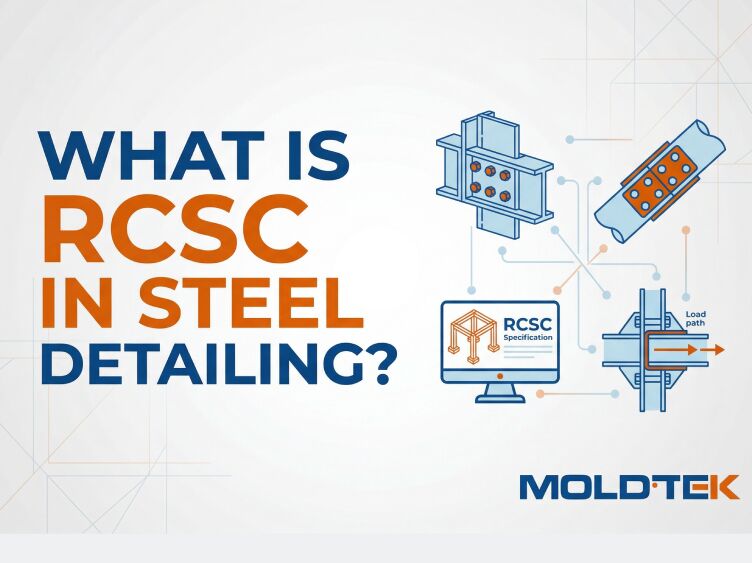
In structural steel construction, RCSC (Research Council on Structural Connections) plays a key role in defining how bolted connections are designed, detailed, and installed. RCSC is an industry body that develops standards to ensure that structural connections using high-strength bolts meet safety, reliability, and performance requirements, often working in alignment with organizations such as the American Institute of Steel Construction (AISC).
In the context of steel detailing, RCSC standards provide guidance on how bolted connections should be represented in shop drawings and erection drawings, ensuring that design intent is accurately translated into fabrication and on-site assembly.
Role of RCSC in Steel Detailing
RCSC establishes standardized practices for structural steel connections, particularly those involving high-strength bolts. These standards ensure that detailing outputs are consistent with engineering requirements and construction practices.
In steel detailing workflows, RCSC guidelines help:
- Define how bolted connections are specified in drawings
- Ensure proper representation of bolt types, sizes, and installation methods
- Align detailing outputs with fabrication and erection requirements
By following RCSC specifications, detailers can produce drawings that minimize ambiguity and improve coordination between design, fabrication, and construction teams.
RCSC Specification for Structural Joints
The primary document developed by RCSC is the “Specification for Structural Joints Using High-Strength Bolts.” This specification provides detailed requirements for the design, installation, and inspection of bolted connections.
It covers:
- Bolt material specifications and strength requirements
- Design criteria for different types of bolted joints
- Installation procedures and tightening methods
- Inspection and quality control requirements
This specification is widely referenced in structural engineering projects and is often aligned with AISC standards and building codes.
Types of Bolt Installation Methods
RCSC defines several methods for installing high-strength bolts, each suited to different structural requirements:
Snug-Tightened Joints
In this method, bolts are tightened to a firm contact level without applying full tension. These joints are typically used where slip between connected elements is acceptable.
Pretensioned Joints
Pretensioned bolts are tightened to a specified tension level, ensuring a higher level of clamping force between connected elements. This method improves connection stability and load transfer.
Slip-Critical Joints
Slip-critical joints are designed to prevent movement between connected surfaces under load. These joints rely on friction generated by properly tensioned bolts and are commonly used in structures where movement must be minimized.
These installation methods must be clearly indicated in detailing drawings to ensure correct implementation during construction.
Inspection and Quality Control
RCSC standards include detailed inspection requirements to verify that bolted connections are installed correctly. Inspection processes ensure that:
- Bolt tension meets specified requirements
- Installation methods are followed correctly
- Connections perform as intended under load
Proper inspection is critical for maintaining structural safety and ensuring that connections comply with project specifications.
Importance of RCSC in Shop and Erection Drawings
In steel detailing, RCSC standards directly influence how bolted connections are documented in both shop drawings and erection drawings.
Shop Drawings
Shop drawings include detailed information on bolt specifications, connection geometry, and installation requirements. RCSC compliance ensures that these details are accurate and fabrication-ready.
Erection Drawings
Erection drawings guide on-site assembly and installation of connections. Clear representation of bolt installation methods and connection types helps avoid errors during construction.
By adhering to RCSC standards, detailing outputs support efficient fabrication and accurate site execution.
Relationship Between RCSC and AISC Standards
RCSC standards are closely aligned with AISC standard of detailing. While AISC focuses on overall structural design and detailing practices, RCSC provides specialized guidance for bolted connections.
Together, these standards ensure that:
- Structural connections are designed safely
- Detailing outputs are accurate and consistent
- Fabrication and erection processes follow established best practices
This integration is essential for maintaining quality and compliance in structural steel projects.
Engineering Design and Detailing Perspective
From an engineering standpoint, RCSC standards are critical for ensuring that bolted connections are accurately represented and properly executed. They help bridge the gap between design calculations and real-world construction by standardizing connection detailing practices.
At Moldtek Engineering, structural steel detailing workflows incorporate industry standards such as RCSC to ensure accuracy, coordination, and compliance in engineering deliverables. This includes preparing detailed connection drawings, specifying bolt requirements, and ensuring alignment with fabrication and erection processes as part of broader structural steel detailing services.
Such alignment is particularly important in infrastructure and industrial applications, where connection detailing directly impacts structural performance and long-term reliability.
Why RCSC Standards Matter in Structural Steel Projects
The application of RCSC standards offers several advantages:
- Ensures safe and reliable bolted connections
- Reduces errors during fabrication and erection
- Improves coordination between engineering and construction teams
- Supports compliance with building codes and project specifications
- Enhances overall structural integrity
As structural projects become more complex, standardized connection detailing becomes essential for maintaining quality and efficiency.
Conclusion
RCSC plays a vital role in steel detailing by providing standardized guidelines for the design, installation, and inspection of bolted connections. Its specifications ensure that structural joints using high-strength bolts are safe, reliable, and compliant with industry requirements.
Understanding RCSC standards is essential for engineers, detailers, and project stakeholders involved in structural steel construction, as they directly influence the accuracy and performance of connection detailing.
This article explains what RCSC (Research Council on Structural Connections) is and its role in steel detailing. It covers standards for high-strength bolted connections, installation methods such as snug-tightened, pretensioned, and slip-critical joints, and inspection requirements to ensure safety, accuracy, and compliance in structural steel construction.

About the Author
By Abhishek Suresh
Deputy Manager – Marketing at Moldtek Technologies
A distinction holder in MSc International Management from Trinity College Dublin and a semi-qualified Chartered Accountant (CA – IPCC from India) with an undergraduate degree in the field of accountancy and finance. I am currently working at Moldtek Technologies Ltd as a Deputy Manager, Marketing, taking care of the entire marketing activities of the business.