
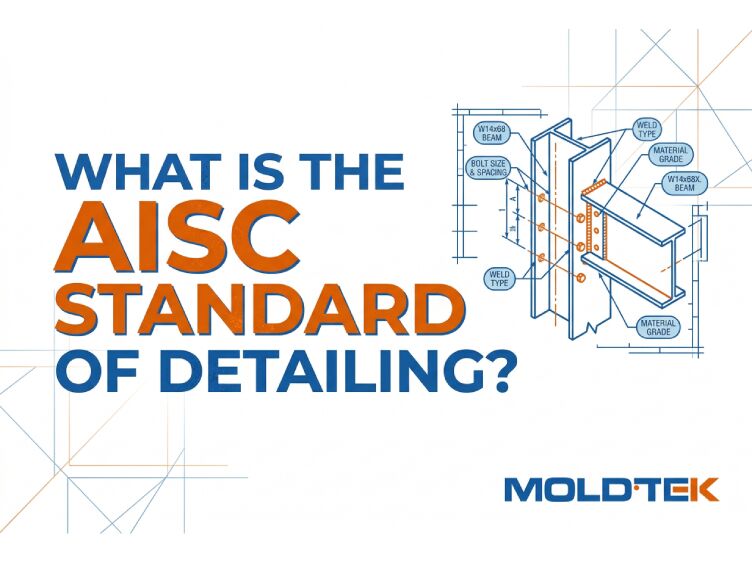
The AISC standard of detailing refers to a set of guidelines and specifications developed by the American Institute of Steel Construction (AISC) to regulate how structural steel components are detailed, fabricated, and erected in construction projects. These standards ensure that steel structures are designed and executed with consistency, safety, and accuracy across different stages of a project.
In structural engineering workflows, detailing plays a critical role in translating design intent into fabrication-ready and erection-ready drawings. AISC standards provide a common framework that defines how this detailing process should be carried out, ensuring alignment between engineers, detailers, fabricators, and contractors.
Role of AISC Standards in Steel Detailing
AISC standards establish a uniform approach to structural steel detailing by defining responsibilities, documentation requirements, and acceptable practices. These standards help eliminate ambiguity in communication between stakeholders involved in design and construction.
By following AISC guidelines, detailing outputs such as shop drawings and erection drawings becomes standardized, making it easier for fabricators to produce components accurately and for site teams to assemble them efficiently. This reduces the risk of errors, rework, and delays during construction.
Key AISC Standards Used in Detailing
AISC 303 – Code of Standard Practice
AISC 303 is the primary standard governing detailing practices. It defines the roles and responsibilities of different stakeholders, including engineers, detailers, and fabricators.
This standard covers:
- Requirements for preparation and approval of shop and erection drawings
- Responsibilities for providing design information
- Tolerances, accuracy, and quality expectations
- Communication protocols between project participants
AISC 303 ensures that detailing outputs meet industry expectations and align with project specifications.
AISC 360 – Specification for Structural Steel Buildings
AISC 360 focuses on the structural design of steel buildings, including requirements for connections and member behavior. It provides guidelines that directly influence detailing decisions, particularly for welded and bolted connections.
This standard helps ensure that:
- Structural members meet strength and stability requirements
- Connection details are safe and constructible
- Load paths are clearly defined and properly transferred
Detailers rely on AISC 360 to interpret design intent and translate it into accurate connection details.
AISC 341 – Seismic Provisions
AISC 341 provides guidelines for detailing steel structures in seismic regions. It introduces additional requirements to ensure that structures can withstand earthquake forces without failure.
This includes:
- Special detailing for ductility and energy dissipation
- Reinforced connection requirements
- Compliance with seismic design categories
For projects located in earthquake-prone areas, AISC 341 plays a critical role in shaping detailing practices.
AISC 325 – Steel Construction Manual
The AISC Steel Construction Manual (AISC 325) is a widely used reference that provides essential data for detailing and design.
It includes:
- Section properties and design tables
- Standard connection configurations
- Material specifications and guidelines
Detailers use this manual as a practical reference to ensure consistency and accuracy in detailing outputs.
NISD Standards and Industry Alignment
The National Institute of Steel Detailing (NISD) works alongside AISC to promote best practices in steel detailing. While AISC provides the core standards, NISD supports training, certification, and quality benchmarks for detailers.
Together, these organizations help maintain a consistent level of quality across the structural steel detailing industry.
Importance of AISC Standards in Shop and Erection Drawings
AISC standards play a crucial role in ensuring that both shop drawings and erection drawings are accurate, complete, and aligned with project requirements.
Shop Drawings
Shop drawings provide detailed information required for fabrication. These include dimensions, material specifications, connection details, and welding or bolting requirements. Following AISC standards ensures that these drawings are precise and free from ambiguity.
Erection Drawings
Erection drawings guide on-site assembly of steel components. They show how members fit together, sequence of installation, and positioning of elements. Compliance with AISC standards ensures smooth coordination during construction.
By adhering to these standards, project teams can minimize errors, improve efficiency, and maintain structural integrity throughout the project lifecycle.
Engineering Design and Detailing Perspective
From an engineering standpoint, the AISC standard of detailing is essential for ensuring that structural steel detailing designs are translated accurately into buildable components. It helps bridge the gap between conceptual design and physical construction by standardizing how information is represented and communicated.
At Moldtek Engineering, structural steel detailing workflows are aligned with internationally recognized standards such as AISC to support consistency, accuracy, and coordination in engineering deliverables. This involves preparing detailed drawings, connection layouts, and documentation that comply with project specifications and applicable standards.
Such alignment ensures that detailing outputs integrate effectively with fabrication processes, erection planning, and overall project execution, particularly in large-scale industrial and infrastructure projects.
Why AISC Standards Matter in Modern Construction
The use of AISC standards in detailing provides several advantages:
- Ensures uniformity across projects and stakeholders
- Reduces errors and rework during fabrication and erection
- Improves communication between design and construction teams
- Enhances safety and structural reliability
- Supports compliance with international engineering practices
As construction projects become more complex, standardized detailing practices become increasingly important for maintaining efficiency and quality.
Conclusion
The AISC standard of detailing forms the foundation of structural steel detailing practices in modern construction. By defining clear guidelines for documentation, responsibilities, and technical requirements, AISC standards ensure that steel structures are designed, fabricated, and erected with precision and reliability.
Understanding these standards is essential for engineers, detailers, and project stakeholders involved in structural steel projects, as they directly impact the quality, safety, and success of construction outcomes.
This article explains the AISC standard of detailing and its role in structural steel construction. It covers key AISC codes such as AISC 303, AISC 360, and AISC 341, along with their relevance in shop drawings, erection drawings, and connection detailing. The content highlights how these standards ensure accuracy, coordination, safety, and consistency across steel detailing, fabrication, and construction processes.

About the Author
By Abhishek Suresh
Deputy Manager – Marketing at Moldtek Technologies
A distinction holder in MSc International Management from Trinity College Dublin and a semi-qualified Chartered Accountant (CA – IPCC from India) with an undergraduate degree in the field of accountancy and finance. I am currently working at Moldtek Technologies Ltd as a Deputy Manager, Marketing, taking care of the entire marketing activities of the business.