
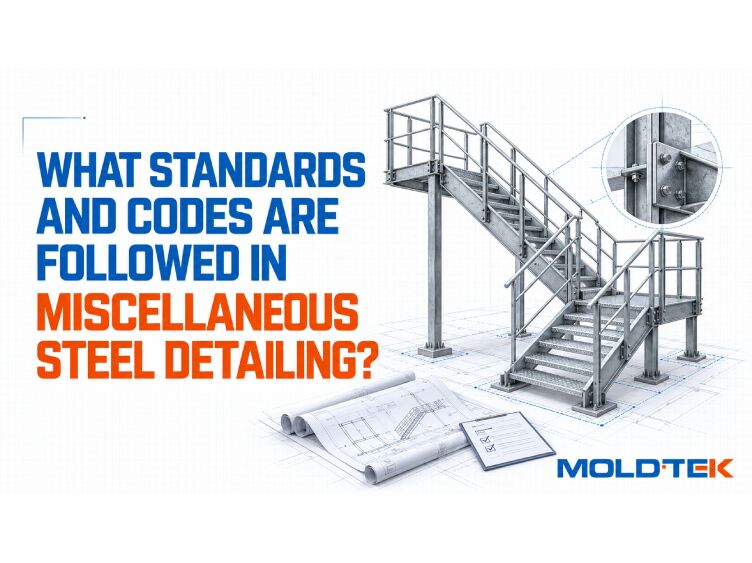
More than a structural steel package typically has to be satisfied. Miscellaneous steel detailing covers stairs, handrails, ladders, platforms, and embed plates, so on top of whatever industry standards a project’s structural steel already meets, detailers follow safety rules under OSHA, accessibility requirements under the ADA, building codes through the IBC or a local equivalent, and design and welding standards from AISC, NISD, AWS, and ASTM.
Why Miscellaneous Steel Answers to More Codes Than Structural Steel
Structural steel detailing on most construction projects mostly answers to one family of design codes: AISC in the US, IS 800 in India, Eurocode across much of Europe, whichever governs the load path for the steel structures a project is built around.
We’ve covered how that scope differs from miscellaneous work in our structural vs. miscellaneous steel detailing comparison. Miscellaneous steel carries that same baseline, then adds a second layer on top of it, because stairs, handrails, and ladders are what people actually climb, hold onto, and walk across every day.
That second layer is where OSHA, ADA, and building codes come in. A stair stringer still has to satisfy the same structural steel design principles as a beam, but it also needs a riser height that meets code, a handrail that grips right, and a landing that clears an egress width. Projects require both layers to line up, and getting them to agree is most of what the detailing process for a miscellaneous steel package actually involves, since it shapes project timelines as much as it shapes the drawings themselves.
Safety and Accessibility Regulations
OSHA
OSHA sets the industrial safety baseline for anything a worker stands on or holds onto. Under OSHA’s walking-working surfaces standard, fall protection requirements kick in once a surface sits 4 feet or more above the level below it, which is why stair rail systems, guardrail height, toe boards on platforms, and cage requirements on fixed ladders show up on almost every miscellaneous steel drawing.
A fabrication and installation package that misses one of these clearances gets caught in the field, not on the drawing, which is exactly the kind of rework a careful detailing process is supposed to prevent.
ADA
The ADA’s 2010 Standards for Accessible Design govern the parts of miscellaneous steel that people with disabilities interact with directly. Handrail gripping surfaces need an outside diameter between 1 1⁄4 and 2 inches, mounting height runs 34 to 38 inches above the stair nosing, and the rail has to extend a set distance past the top and bottom riser. These numbers are tighter and less forgiving than most structural tolerances. A handrail a half-inch off code height isn’t a structural failure, but it is a compliance one.
IBC and Local Building Codes
The IBC, or whatever local building code a jurisdiction has adopted, sets the legal minimums a project has to hit: live loads for platforms and stairs, minimum egress widths, and geometric limits on riser height and tread depth. These numbers vary by occupancy type and jurisdiction, which is why miscellaneous steel detailing tends to be project specific in a way structural framing sometimes isn’t. The same stair design that passes review in one city can get flagged in another.
Quick Reference: Codes That Govern Miscellaneous Steel Detailing
| Standard | What It Governs | Applies To |
| OSHA 1910.28 | Fall protection, guardrails, stair rail systems | Stairs, platforms, fixed ladders |
| ADA (2010 Standards) | Accessibility dimensions, handrail specs | Handrails, stair nosings, ramps |
| IBC / local codes | Live loads, egress width, riser and tread limits | Stairs, platforms, egress routes |
| AISC 303 | Fabrication tolerances, drawing responsibilities | Shop and erection drawings |
| NISD | Drawing conventions and formats | Shop and erection drawings |
| AWS D1.1 | Structural welding, carbon and low-alloy steel | Stair stringers, handrail posts |
| AWS D1.3 / D1.6 | Sheet steel and stainless steel welding | Architectural handrails, gratings |
| ASTM specs | Material properties for shapes, plates, fasteners | All miscellaneous steel components |
Design and Detailing Manuals
Two references sit underneath the safety codes, shaping how the actual detailing drawings get built rather than what the finished component has to do.
AISC, mainly through AISC 303, the Code of Standard Practice, sets general alignment: fabrication tolerances, drawing responsibilities, and baseline expectations for detailed fabrication and erection drawings across a project, miscellaneous steel components included. We’ve broken down AISC’s detailing standards in more depth in an earlier post, since the code applies as much to structural steel detailing as it does to miscellaneous components.
NISD, the National Institute of Steel Detailing, works alongside AISC on the practical side: drawing conventions, symbols, and shop and erection drawing formats that keep a set of detailing drawings readable across different detailers, fabricators, and reviewers. It’s less about what a component has to withstand and more about making sure everyone reading the drawing set interprets it the same way.
Welding and Material Codes
Once the geometry and the safety numbers are locked in, welding and material codes govern the fabrication processes behind how the pieces actually get joined and what they’re made of.AWS D1.1 is the structural welding code most miscellaneous steel connections fall under, covering carbon and low-alloy steel, which is most stair stringers, handrail posts, and platform framing. AWS D1.3 and D1.6 cover thinner sheet steel and stainless steel specifically. That distinction matters more in miscellaneous work than in primary framing, since architectural handrails, gratings, and some canopy work use lighter-gauge or stainless material that D1.1 doesn’t fully address.
ASTM specifications sit underneath both AWS codes, defining the material properties for the structural shapes, plates, threaded fasteners, and connection details a detailer specifies on the drawing. A steel design decision as small as whether a handrail post is standard carbon steel or stainless traces back to an ASTM spec before it ever reaches a welding code.
How These Standards Come Together on One Project
A single stairs-and-rails package on a real project rarely deals with just one of these codes at a time. A stair stringer has to satisfy AISC for its steel design, OSHA for the geometry, the IBC for egress and live load, and AWS for its welds and connection details, all on the same drawing. Quality control on a miscellaneous steel detailing project shapes project execution directly, since a stair that passes OSHA but misses an IBC riser limit still fails review and stalls the schedule.
International projects add another layer. A project built to Eurocode or IS 800 instead of AISC still needs equivalent accessibility and building-code coverage, so the OSHA and ADA references above get swapped for whatever international standards the local jurisdiction actually enforces. The codes change; the underlying discipline, checking every human-access component against every applicable rule before fabricating and installing a single piece, doesn’t.
The Bottom Line on Standards and Codes in Miscellaneous Steel Detailing
None of these codes get checked one at a time on paper anymore. Most miscellaneous steel detailing today happens inside BIM models built in Tekla Structures, which creates detailed 3D models carrying OSHA clearances, ADA dimensions, and IBC geometry directly into the shop drawings instead of leaving them to be cross-referenced by hand across five different code books.
That’s really what all of this is in service of: steel construction that goes together right the first time, on construction projects where detailers ensure every applicable standard gets checked before fabrication starts, not after. Detailing drawings that account for every code up front are what protect project timelines and keep steel fabrication on schedule, instead of turning into a punch list of code violations found after installation.
Firms that build miscellaneous steel detailing services around this kind of cross-checked process are the ones consistently delivering high-quality, cost-effective outcomes instead of relying on field fixes to catch what the drawings missed.
Frequently Asked Questions
What is the main standard for miscellaneous steel detailing?
There isn’t a single one. Miscellaneous steel detailing typically has to satisfy AISC for fabrication tolerances, OSHA for worker safety, the ADA for accessibility, and the IBC or local building code for egress and load requirements, all on the same component.
Does OSHA apply to miscellaneous steel detailing?
Yes. OSHA’s walking-working surfaces standard covers stair geometry, guardrail height, toe boards, and fixed ladder cages, since these are the components workers stand on and hold onto during and after construction.
What ADA requirements affect handrail design?
The ADA sets handrail gripping surface diameter, mounting height, extension length past the top and bottom riser, and clearance dimensions at platforms and ramps for wheelchair access.
What welding code applies to stainless steel handrails?
AWS D1.6 covers stainless steel welding specifically, while AWS D1.1 covers the carbon and low-alloy steel used in most structural and miscellaneous steel connections.
Do international projects follow different standards?
Yes. A project built to Eurocode or IS 800 instead of AISC still needs local equivalents for accessibility and building-code compliance, so the specific codes referenced change even though the underlying detailing process doesn’t.
Conclusion
Miscellaneous steel detailing sits at the intersection of more codes than most people expect: AISC and NISD for how the drawings get built, OSHA and the IBC for what a worker or occupant needs to be safe, the ADA for what someone in a wheelchair needs to get through, and AWS and ASTM for what the steel is made of and how it’s joined.
None of these standards work in isolation on a real project, and checking a component against all of them at once, inside a coordinated 3D model rather than by hand, is what keeps a stairs-and-rails package out of the field-fix pile.
Explore More on Miscellaneous Steel Detailing

About the Author
By Abhishek Suresh
Deputy Manager – Marketing at Moldtek Technologies
A distinction holder in MSc International Management from Trinity College Dublin and a semi-qualified Chartered Accountant (CA – IPCC from India) with an undergraduate degree in the field of accountancy and finance. I am currently working at Moldtek Technologies Ltd as a Deputy Manager, Marketing, taking care of the entire marketing activities of the business.