
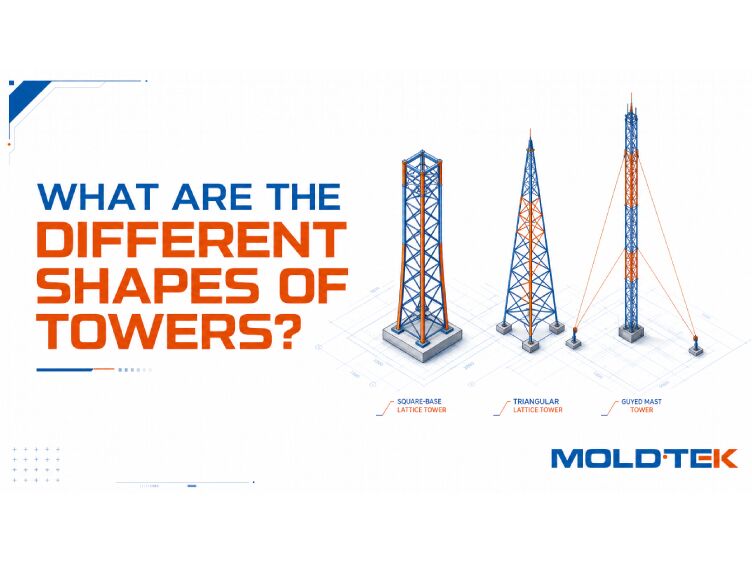
Tower structures are designed in a variety of shapes depending on their purpose, height, environmental conditions, load requirements, and aesthetic considerations. The shape of a tower plays a significant role in determining its structural stability, wind resistance, material efficiency, and overall performance.
From telecommunications and transmission towers to observation towers and architectural landmarks, engineers select tower shapes that balance strength, functionality, and constructability.
Understanding the different shapes of towers helps explain how these structures are optimized to withstand environmental forces while supporting their intended applications. While tower shapes define the geometry of a structure, there are also various types of telecom towers designed for different operational requirements.
Why Tower Shape Matters
The shape of a tower directly affects:
- Structural stability
- Wind load resistance
- Load distribution
- Material consumption
- Construction feasibility
- Visual appearance
Selecting an appropriate shape helps ensure that towers support operational requirements while improving performance, safety, and long-term durability.
Common Shapes of Towers
Several geometric shapes are commonly used in tower construction. Each shape offers unique structural and functional advantages.
1. Square Towers
Square towers feature four sides of equal length and are among the most widely used tower shapes.
Characteristics include:
- Symmetrical load distribution
- Simple structural configuration
- Ease of fabrication and construction
- Good stability for medium and high-rise tower structures
Square-shaped towers are commonly used in industrial structures, observation towers, and certain telecommunications applications.
2. Rectangular Towers
Rectangular towers have longer sides in one direction, creating a shape that differs from a square footprint.
Benefits include:
- Greater flexibility for equipment placement
- Efficient use of available space
- Adaptability to specific site requirements
Rectangular tower shapes are often used where functional or site constraints influence structural layout.
3. Round or Cylindrical Towers
Round towers feature a circular cross-section and are known for their aerodynamic properties.
Advantages include:
- Reduced wind resistance
- Uniform load distribution
- Improved structural efficiency
- Enhanced resistance to lateral forces
Because wind flows more smoothly around curved surfaces, cylindrical towers are often used in applications where wind loading is a significant design consideration. These aerodynamic characteristics are often considered during telecom tower structure design to improve stability and performance.
Examples include:
- Water towers
- Lighthouses
- Observation towers
4. Octagonal Towers
Octagonal towers have eight sides and combine some of the benefits of both square and circular shapes.
Key characteristics include:
- Improved aerodynamic performance
- Enhanced structural rigidity
- Balanced load distribution
- Distinct architectural appearance
Historically, octagonal towers have been used in watchtowers, religious structures, and landmark buildings.
5. Tapered Towers
Tapered towers gradually reduce in width as they increase in height.
This shape provides several engineering advantages:
- Reduced self-weight at higher elevations
- Improved stability
- Better wind load management
- Efficient material utilization
Many modern towers and tall structures use tapered profiles because they help reduce structural stresses while maintaining strength.
6. Conical Towers
Conical towers are shaped like a cone, with a broad base and a narrower top.
Benefits include:
- Strong foundation support
- Efficient load transfer
- Improved resistance to overturning forces
Conical shapes are commonly used in structures where stability is a primary design consideration.
7. Pyramidal Towers
Pyramidal towers feature a wide base that gradually narrows toward the top.
This shape is commonly used because:
- It provides excellent structural stability
- It distributes loads efficiently
- It reduces bending stresses
- It performs well under wind loading
Pyramidal forms are frequently used in electrical transmission tower designs that carry power lines across long distances because of their strength-to-weight efficiency. Their structural configuration makes them well-suited for utilities and power transmission design applications.
8. Multi-Faceted and Sculptural Towers
Modern tower construction increasingly incorporates multi-faceted and architecturally unique shapes.
These structures may include:
- Curved profiles
- Twisting geometries
- Faceted surfaces
- Hybrid geometric forms
Such designs are often developed to:
- Improve aerodynamic performance
- Enhance architectural appeal
- Optimize structural efficiency
Many contemporary landmark towers and observation structures utilize custom-shaped designs tailored to specific project goals.
Factors Influencing Tower Shape Selection
Engineers evaluate several factors when determining the most suitable tower shape. Depending on their application, towers are typically designed to balance structural stability, wind resistance, functionality, and material efficiency.
These include:
Wind Conditions
Wind loads often have a significant influence on tower geometry. Rounded and tapered shapes generally offer better aerodynamic performance.
Height Requirements
As tower height increases, structural efficiency becomes increasingly important. Tapered and pyramidal forms are often preferred for taller structures.
Functional Requirements
The intended use of the tower designed for a specific application affects shape selection. Equipment loads, maintenance access, and operational requirements all influence the final design.
Architectural Considerations
For landmark and commercial structures, visual appearance and integration with the surrounding area may be as important as structural performance.
Material Efficiency
Optimized shapes help reduce material consumption while maintaining strength and stability.
Summary: What Are the Different Shapes of Towers?
Common tower shapes include square, rectangular, round, cylindrical, octagonal, tapered, conical, pyramidal, and multi-faceted forms. Each shape offers unique advantages related to structural stability, wind resistance, load distribution, and construction efficiency. The selection of a tower shape depends on project requirements, environmental conditions, and engineering objectives.
Conclusion
Tower shape plays a critical role in determining the performance and efficiency of steel structures used across infrastructure, utility, and communication applications. Whether square, cylindrical, octagonal, tapered, or pyramidal, each shape is selected to meet specific structural and functional requirements. By understanding the different shapes of towers, engineers can design structures that balance strength, stability, durability, and efficiency for a wide range of applications.
The primary purpose of structural steel detailing is to transform engineering designs into precise fabrication and construction instructions. Through detailed drawings, BIM models, and coordinated documentation, detailing ensures structural integrity, fabrication accuracy, compliance with building codes, and efficient on-site assembly. Through detailed drawings, BIM models, and coordinated documentation, structural detailing helps ensure structural integrity, fabrication accuracy, regulatory compliance, and efficient on-site assembly. By bridging the gap between design and construction, detailing plays a critical role in reducing errors, improving coordination, and supporting successful project execution.

About the Author
By Abhishek Suresh
Deputy Manager – Marketing at Moldtek Technologies
A distinction holder in MSc International Management from Trinity College Dublin and a semi-qualified Chartered Accountant (CA – IPCC from India) with an undergraduate degree in the field of accountancy and finance. I am currently working at Moldtek Technologies Ltd as a Deputy Manager, Marketing, taking care of the entire marketing activities of the business.