
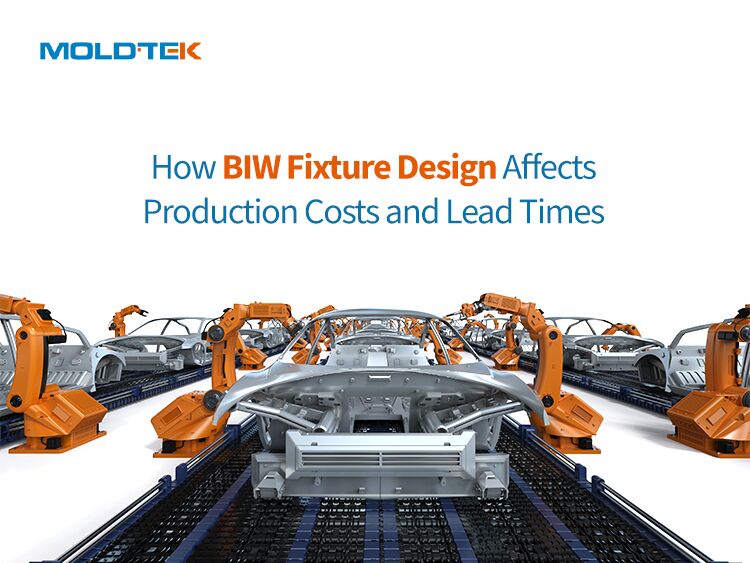
How BIW Assembly Fixture Design Affects Production Costs and Lead Times
Efficiency and effectiveness are paramount in this growing world of automotive manufacturing. BIW fixture design is one of the critical elements that significantly impacts production costs and influences lead times. Body in White (BIW) is a stage in automobile manufacturing where the body of a car is welded together. These fixtures are engineered to hold, position, and align components accurately during BIW assembly, welding, and inspection processes.
In this blog, let us understand how BIW fixture design affects production costs and lead time. We will also understand its execution in the manufacturing design process and the importance of meticulous planning.
Understanding the Role of Fixtures in BIW Assembly
Fixtures play an integral role in automotive BIW assembly by ensuring accurate positioning, repeatability, and dimensional consistency during production. Fixtures are specific tools used to tightly hold the component in place while assembling, inspecting, and welding. The fixture design’s precision influences the quality and accuracy of the finished product. These fixture designs ensure that parts are correctly placed, reducing rework and errors. This check is essential in automobile design, as even a minor deviation can lead to significant issues down the line.
Impact on Production Costs
BIW welding fixture design has a crucial role in managing production costs. Let us see a few ways in which it is affecting production costs:
1. Material Usage
Fixture designs, when effectively designed, optimize materials usage and reduce waste. They help position parts precisely, thus reducing the need for additional material to cover up errors, leading to cost savings.
2. Labour Efficiency
Well-designed fixtures simplify the assembling process, reducing laborers’ efforts and time. On the whole, it enhances the overall productivity while lowering the labor costs.
3. Tooling Costs
High-quality manufacturing fixture design requires massive initial investments; however, it pays off in the long run. Sturdy fixtures can reduce the frequency of repairs and replacements, leading to lowered tooling costs over time.
4. Error Reduction
Accuracy in fixture planning and execution minimizes errors during BIW assembly. Reducing errors ultimately reduces work and scrap, directly reducing production costs. This reduction is crucial for maintaining the cost-effectiveness of automobile manufacturing.
Influence on Lead Times
The total time taken from the production’s beginning to the product’s completion is called lead time. It is a critical factor in the competitive automotive manufacturing industry. The influence of BIW fixture design is significant in lead times through various forms:
1. Streamlined Assembly Process
Efficient fixtures smoothen the process of assembling and ensure that parts are positioned securely and correctly. This minimizes the time required for alignment and adjustments thus speeding up the overall production cycle.
2. Reduced Setup Times
Well-designed fixtures reduce the setup times between different production stages as they are easy to set up and adjust. Reducing setup time is crucial in the BIW assembly line for quick transactions to maintain high production rates.
3. Minimized Downtime
Sturdy and Reliable fixtures can reduce downtime caused by maintenance or breakdowns. Maintaining constant production flow and meeting the tight deadlines in automobile manufacturing is essential.
4. Consistent Quality
BIW fixture design aids in maintaining consistent quality throughout the production process by ensuring accurate alignment and placement. Consistent quality can minimize the time consumed for inspections and work, thus shortening the lead times.
Role in Product Lifecycle Management
Managing the entire lifecycle of a product in the automotive industry is termed Product Lifecycle Management(PLM). It involves all activities from inception through engineering design and manufacturing to service and disposal. BIW fixture design has a significant role in PLM as it ensures the production process is efficient, scalable, and cost-efficient.
1. Design Integration
It is essential to integrate BIW fixture design in the early stages of automobile design as it ensures that manufacturing considerations are taken into account from the outset. It avoids the need for expensive and time-consuming design changes later on, leading to more manufacturable designs.
2. Lifecycle Cost Management
Effective fixtures help to lower the lifecycle costs by decreasing material usage, tooling costs, and labor. It reduces the replacement and maintenance costs over the product’s lifecycle by improving the reliability and durability of fixtures.
3. Scalability
Well-developed fixtures are scalable and versatile. They allow manufacturers to ramp up production to meet the growing demand without any remarkable redesign and investment. This flexibility is essential to maintain a competitive advantage in the dynamic automotive manufacturing industry.
Integration with Advanced Technologies
Incorporating advanced digital tools such as simulation models, virtual prototyping, and digital twins is transforming how fixtures are planned and validated in BIW manufacturing. It is changing the manufacturer’s approach towards manufacturing design and fabrication design. These advanced technologies result in better designs and enhanced outcomes because they enable precise simulation and visualization of assembling processes and fixtures.
1. Digital Prototyping
Engineers can create and test fixture designs in a virtual environment using digital prototyping. This decreases the necessity of physical prototypes and saves time and resources. This ensures the optimal design before the commencement of physical production.
2. Data-Driven Design
Data-driven approaches and advanced analytics validate constant enhancement in fixture designs. It helps engineers by analyzing the data from previous production runs. With this, engineers can identify areas for improvement and refine fixtures to reduce costs and enhance efficiency.
3. Collaboration and Communication
These advanced digital tools allow collaboration and communication among engineering, design, and production teams. This is done to make sure that everyone is aligned and that the fixture designs meet the demands of all stakeholders.
Conclusion
BIW fixture design plays a significant role in the efficiency and cost-effectiveness of automotive BIW production processes. Fixture designs significantly impact production costs and lead time through optimal material usage, enhanced labor efficiency, decreased errors, and integration of advanced technologies. Effective planning and implementation of BIW assembly fixtures is essential for controlling production costs, maintaining competitive lead times, and ensuring consistent quality in automotive manufacturing environments.
To understand how BIW fixture planning fits within broader automotive engineering and production requirements, explore our automotive BIW design services.
Because they maintain a competitive edge and deliver superior products to the market efficiently and cost-effectively. As the industry continues to evolve, the role of BIW fixture design in shaping the future of automotive manufacturing will become more significant.

About the Author
By Vamsi Posemsetty
EVP – Global Strategy & Operations, Moldtek Technologies
Founder & CEO, Zenitude Technologies
Vamsi Posemsetty brings 20+ years of global experience in manufacturing, engineering services, and enterprise technology transformation. At Moldtek, he leads strategy and delivery across structural steel detailing, BIM modeling, and industrial projects.
He has held leadership roles at Microsoft, Tata Motors, Mahindra & Mahindra, and GE across the US, Europe, and Asia. Now at Zenitude Technologies, he focuses on AI-powered platforms for industrial upskilling.
A thought leader in real-world AI adoption in engineering, Vamsi was part of ISB Hyderabad’s founding cohort (Business Analytics, 2013) and is the upcoming author of “AIM: Unlocking the AI Mindset.”