
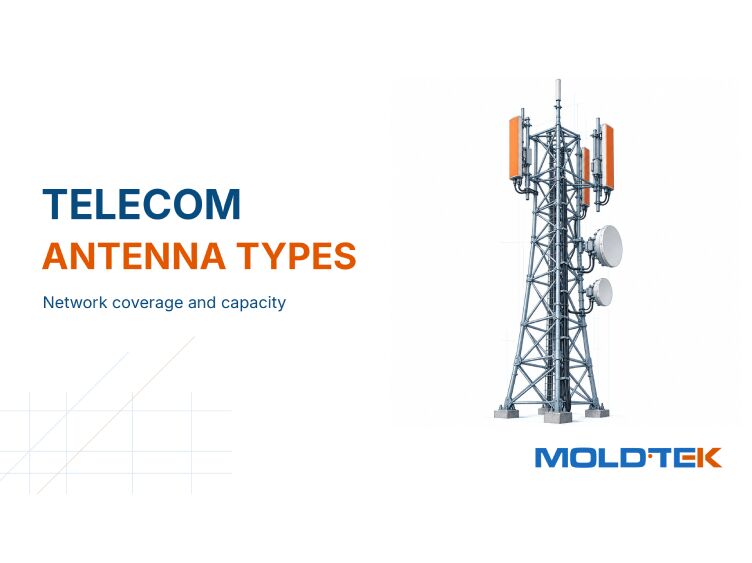
Every bar of signal on your phone traces back to an antenna somewhere, turning electrical current into radio waves and back again. But there is no single antenna that does it all. A tower beaming coverage across a suburb, a dish linking two towers over long distances, and a small unit tucked into a stadium ceiling are built on very different designs.
This guide walks through 10 of the most common telecom antenna types used for network coverage and capacity, what each one does, and where it fits in a real network. One thing to know up front: this list mixes antenna designs (such as dipole, panel, and dish) with deployment use cases (such as small cell and indoor), so the categories overlap rather than forming ten cleanly separate types.
A panel and a sector antenna are closely related, and a microwave antenna is usually a kind of dish. Treat the list as a practical tour of what you will see on real sites, not a rigid taxonomy. We will start with how an antenna works, then go through the common types one by one.
How an Antenna Works: The Basics
At its core, every antenna converts electrical signals into an electromagnetic wave that travels through the air, and receives the same in reverse. How that energy is shaped, whether it spreads out broadly or focuses into a tighter beam, is what distinguishes one design from another. The amount of radiated power and how it is directed influences how far and how precisely a signal reaches.
Two ideas run through the whole list. Gain describes how tightly an antenna concentrates its energy: a higher-gain antenna generally sends a stronger signal in a preferred direction or shape, while a lower-gain design spreads coverage more widely. Higher gain does not always mean a single narrow beam, though; a high-gain sector antenna, for example, still covers a wide arc, just more efficiently within it. Radiation pattern describes the actual shape of that coverage, from the broad horizontal spread of an omnidirectional antenna to the pencil beam of a parabolic reflector. Keep both in mind and the designs below make sense.
A few building blocks show up again and again across these designs. The simplest is the dipole antenna, two conductive elements fed in the middle, and its close cousin the folded dipole, which widens bandwidth and is the driven element inside many Yagi designs. An omni on a mast often sits above a ground plane, a flat conductive base that reflects and shapes the signal.
For focused, high-frequency links, horn antennas flare out like a trumpet to direct the beam, and they are frequently paired with dish reflectors. Traditionally, an antenna connects back to its radio through coaxial cables, though modern active antenna systems increasingly integrate the radio into the antenna unit itself, reducing or removing that cable run.
10 Common Types of Antennas in Telecom
1. Sector Antenna
The sector antenna is a mainstay of mobile coverage. It is a directional panel that radiates over a set beam width, typically 65, 90, or 120 degrees, and it is a standard choice on 2G, 3G, 4G, and 5G macro tower sites. Mounting three of them around a tower is a common way to approximate full 360-degree coverage, though whether the beams truly cover the whole area depends on the chosen radiation pattern, the antenna down-tilt, and the overall site design.
2. Omni Antenna
The omni antenna takes a broader approach, radiating roughly 360 degrees in the horizontal plane in a donut-shaped pattern around its mast, rather than equally in every direction (there is little signal straight up or down). This omnidirectional antenna is common in Wi-Fi access points, small cells, IoT networks, and rural site coverage, anywhere a single unit needs to serve users all around it rather than one sector.
3. Microwave Antenna (Dish)
The microwave antenna, usually a form of dish, establishes high-capacity point-to-point links between two fixed points. Its main job is backhaul: carrying traffic from one tower to another over long distance wireless hops where laying physical fibre is not practical. Because it focuses energy into a narrow beam, it moves large amounts of data cleanly between sites. It overlaps heavily with the dish antenna below; the difference is more about use case than a fundamentally separate design.
4. Massive MIMO Antenna
The massive MIMO antenna is central to modern 5G capacity. It packs large multi-element arrays that use spatial multiplexing and dynamic beamforming to steer many signals at once, so the same site can serve multiple users and data streams simultaneously. These antennas increase capacity significantly in busy areas, often without adding more towers.
5. Panel Antenna
The panel antenna is a flat, compact directional unit, often with moderate to high gain, which makes it easy to mount on poles or walls. It is a common choice for LTE and 5G deployment where a clean, low-profile directional signal is needed. It is closely related to the sector antenna; in practice the two overlap, with sector antennas being panel antennas configured for macro-cell coverage.
6. Dish Antenna (Satellite / RF)
The dish antenna, in its satellite or long-range RF form, uses a parabolic reflector to focus radio waves into a very narrow beam for long-distance communication. The curved metallic surface gathers and concentrates the signal onto a single feed point, which is what gives satellite links and long-range microwave networking their reach across long distances. As noted above, the microwave antenna is essentially a dish used for terrestrial backhaul.
7. Small Cell Antenna
The small cell antenna is a compact, low-power unit designed for localised traffic rather than wide coverage. These are deployed along dense urban streets, in smart cities, airports, and stadiums, adding capacity exactly where crowds concentrate and a big macro tower cannot reach efficiently. Small cell is really a deployment category; the antenna inside can be omni or panel-type.
8. Indoor Antenna
The indoor antenna distributes cellular and Wi-Fi signals inside large structures where outdoor towers struggle to penetrate. Ceiling- or wall-mounted inside offices, shopping malls, and hospitals, these units are usually part of a distributed antenna system that keeps coverage strong deep inside a building. Like small cell, this is a use case more than a single antenna design.
9. Yagi Antenna
The Yagi antenna, properly the Yagi-Uda antenna, is a directional, narrow-beam element antenna built from a driven element, a reflector, and several directors in a line. That design gives it strong gain in one direction, which makes it a classic choice for long-range point-to-point links and specialised RF monitoring. It is the same antenna family many people recognise from rooftop TV aerials.
10. GPS Antenna
The GPS antenna rounds out the list, and its job is timing, not coverage. It receives satellite signals, part of the wider GNSS family, to provide precise time and frequency references that help keep base stations synchronised across the network. GNSS is one common timing source, but it is not the only option: network-based methods such as Precision Time Protocol (PTP) can also deliver synchronisation, and many sites use a combination for resilience.
How to Match the Antenna Type to the Job
Put these together and a pattern emerges, with the overlaps in mind. Some antennas are built to spread coverage broadly (omni, sector, panel), some to focus it far (microwave, dish, Yagi), some to pack in capacity (massive MIMO, small cell), and some to serve a special job (indoor, GPS). A real network blends them, matching each antenna to the coverage or capacity problem in front of it rather than treating the categories as strict silos.
Understanding these roles matters because the antenna is only as useful as the structure holding it. The mounting, the tower, and the loads all have to be engineered around the antenna’s size, weight, and wind profile, which is where structural engineering meets RF planning on every site.
Why Antenna Choice and Tower Design Go Together
The short version: there is no single best antenna, only the right one for the job. Coverage antennas cast a wide net, capacity antennas pack more users into a small area, and backhaul and timing antennas keep the network connected and synchronised. Together, these common types of antennas are what turn a field of towers into a working mobile network.
For anyone planning tower infrastructure, the antennas drive much of the structural load, so the structure and the antenna layout have to be designed together. Our telecom tower structure design team works at exactly that intersection, engineering the tower structures, mounts, and antenna loading so the equipment is carried safely for the long haul.
Frequently Asked Questions
What are the 10 common types of telecom antennas?
This commonly cited list includes the sector antenna, omni antenna, microwave dish, massive MIMO antenna, panel antenna, dish antenna, small cell antenna, indoor antenna, Yagi antenna, and GPS antenna. It mixes antenna designs with deployment use cases, so some entries overlap (sector and panel, microwave and dish) rather than being ten fully distinct types.
What is the difference between a directional and an omnidirectional antenna?
A directional antenna, such as a sector, panel, or Yagi antenna, concentrates its radiated power toward a preferred direction or arc. An omnidirectional antenna radiates roughly 360 degrees in the horizontal plane in a donut-shaped pattern, which suits Wi-Fi, small cells, and rural coverage. The difference is the shape of the radiation pattern, not simply narrow versus wide.
Which antenna types are used for long distances?
Higher-gain antennas such as parabolic dishes and Yagi antennas are used to send signals over long distances, because they concentrate radio waves into a focused beam. Microwave dishes handle tower-to-tower backhaul, while satellite dishes reach much further using a parabolic reflector.
Why do cell towers use a GPS antenna?
A GPS antenna receives satellite signals (part of GNSS) to provide a precise timing reference that helps synchronise a base station with the network. GNSS is one option; network-based methods such as PTP can provide synchronisation too, and many sites use more than one source for resilience.

About the Author
By Abhishek Suresh
Deputy Manager – Marketing at Moldtek Technologies
A distinction holder in MSc International Management from Trinity College Dublin and a semi-qualified Chartered Accountant (CA – IPCC from India) with an undergraduate degree in the field of accountancy and finance. I am currently working at Moldtek Technologies Ltd as a Deputy Manager, Marketing, taking care of the entire marketing activities of the business.