
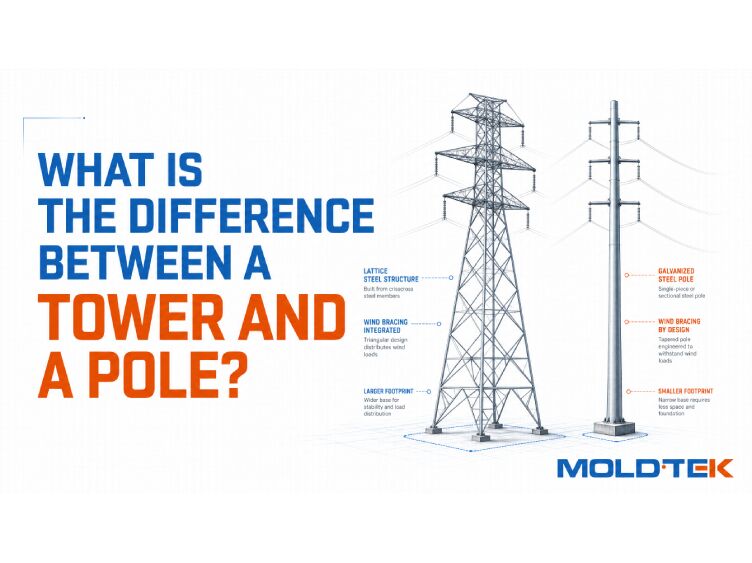
Towers and poles are commonly used in utility, telecommunications, transmission, and infrastructure projects to support equipment, cables, antennas, and electrical systems. Although these structures may appear similar at first glance, they differ significantly in terms of design, load-bearing capacity, stability, and application.
Understanding the difference between a tower and a pole is important for selecting the right structure based on project requirements, environmental conditions, and operational demands.
In simple terms, a pole is a single vertical support structure designed for lighter loads and smaller installations, while a tower is a larger and more complex structure designed to support heavier loads and withstand greater environmental forces.
Understanding Towers and Poles
Both towers and poles serve the purpose of supporting equipment and infrastructure components above ground level.
However, their structural configuration and performance characteristics vary considerably.
The choice between a tower and a pole depends on factors such as load requirements, site conditions, cost effectiveness, and long-term operational needs.
- Load requirements
- Installation location
- Available space
- Wind conditions
- Height requirements
- Operational needs
Understanding these differences helps engineers determine the most suitable solution for a particular application.
Structural Design Differences
One of the most significant differences between towers and poles is their structural design.
Poles
Poles, including the commonly used steel pole, consist of a single continuous vertical shaft.
Their stability is achieved through:
- Foundation depth
- Base diameter
- Material strength
- Structural rigidity
Poles are typically designed with a simple profile that requires minimal ground space.
Towers
Towers generally use a multi-member structural system, often configured as a lattice tower to improve load distribution and structural stability.
Their design often incorporates:
- Multiple structural members
- Bracing systems
- Wide base configurations
- Load-distribution frameworks
This structural arrangement allows towers to distribute loads more effectively and maintain stability at greater heights.
As a result, towers are generally capable of supporting significantly higher loads than poles.
Load-Bearing Capacity
Load capacity is another major factor that distinguishes towers from poles.
Poles
Poles are commonly used for applications involving:
- Lightweight equipment
- Smaller communication systems
- Distribution infrastructure
- Local utility networks
Because they rely on a single support member, their load-bearing capacity is comparatively limited.
Towers
Towers are designed to accommodate:
- Heavy equipment loads
- Multiple communication systems
- High-capacity transmission infrastructure
- Large antenna arrays
Supporting these complex installations requires careful telecom tower structure design to ensure stability, safety, and long-term performance. Their structural configuration enables them to support substantial vertical and lateral loads while maintaining stability under challenging conditions.
Stability and Resistance to Environmental Forces
Environmental factors such as wind loads, ice, and seismic activity can have a significant impact on elevated structures.
Poles
Poles primarily rely on the strength of a single shaft and foundation system to resist external forces.
Their performance is influenced by:
- Pole material
- Foundation design
- Installation depth
- Height-to-diameter ratio
Towers
Towers distribute environmental loads through multiple structural members.
This allows them to:
- Improve wind resistance
- Reduce structural stress concentrations
- Maintain stability at greater heights
- Support larger equipment configurations
Because of this load-sharing capability, towers are often selected for demanding environments where higher structural performance is required.
Space Requirements
The amount of land available for installation is another important consideration.
Poles
Poles have a relatively small footprint because they occupy minimal ground space.
Benefits include:
- Easier installation
- Reduced land requirements
- Suitability for urban environments
- Minimal site disruption
Towers
Towers generally require a larger installation area because of their wider structural footprint and foundation requirements.
This additional space supports:
- Improved stability
- Higher load capacities
- Greater structural efficiency
As a result, towers are more commonly used where adequate space is available.
Height Considerations
Both towers and poles can be designed to achieve significant heights.
However, structural efficiency often influences which solution is selected.
Poles
Poles are commonly used for moderate-height installations where compactness and simplicity are priorities.
Towers
Towers are often preferred for taller installations because their structural framework allows them to maintain stability and support heavier loads at increased elevations.
This makes towers suitable for projects requiring substantial height and equipment capacity.
Maintenance and Accessibility
Maintenance requirements can also differ between towers and poles.
Poles
The simpler design of poles can make inspections and maintenance activities relatively straightforward.
Towers
Towers contain multiple structural members, connections, and support components that may require more extensive inspection and maintenance procedures.
However, their design often provides greater flexibility for accommodating future equipment additions or modifications.
Common Applications
The differences between towers and poles influence where they are commonly used.
Poles Are Often Used For:
- Utility distribution lines
- Street lighting systems
- Smaller communication installations
- Signage support structures
Towers Are Often Used For:
- Telecommunications infrastructure, including various types of telecom towers
- High-voltage transmission lines used for power transmission towers
- Broadcasting installations
- Large communication networks
The selection depends on project-specific structural and operational requirements.
Key Differences Between Towers and Poles
| Feature | Pole | Tower |
| Structure | Single vertical member | Multi-member structural framework |
| Load Capacity | Lower | Higher |
| Stability | Relies on a single shaft and foundation | Distributed across multiple members |
| Footprint | Smaller | Larger |
| Space Requirement | Minimal | Greater |
| Equipment Support | Limited | Extensive |
| Height Capability | Moderate to high | High |
| Structural Complexity | Simpler | More complex |
Summary: What Is the Difference Between a Tower and a Pole?
The primary difference between a tower and a pole lies in their structural design and load-bearing capacity. Poles use a single vertical support and are generally suited for lighter loads, smaller installations, and limited space conditions. Towers use a multi-member structural framework that provides greater stability, higher load capacity, and improved performance in demanding environments. The choice between a tower and a pole depends on factors such as load requirements, available space, height, and operational objectives.
Conclusion
Although towers and poles serve similar support functions, they are designed for different structural and operational needs. Poles offer a compact and efficient solution for lighter applications, while towers provide the strength, stability, and capacity required for larger infrastructure systems. The final selection often depends on performance requirements, available space, and long-term operational considerations. Understanding these differences helps engineers select the most appropriate structure for a project’s technical and environmental requirements.
The primary difference between a tower and a pole lies in their structural design and load-bearing capacity. Poles use a single vertical support and are generally suited for lighter loads, smaller installations, and limited space conditions. Towers use a multi-member structural framework that provides greater stability, higher load capacity, and improved performance in demanding environments. The choice between a tower and a pole depends on factors such as load requirements, available space, height, and operational objectives.

About the Author
By Abhishek Suresh
Deputy Manager – Marketing at Moldtek Technologies
A distinction holder in MSc International Management from Trinity College Dublin and a semi-qualified Chartered Accountant (CA – IPCC from India) with an undergraduate degree in the field of accountancy and finance. I am currently working at Moldtek Technologies Ltd as a Deputy Manager, Marketing, taking care of the entire marketing activities of the business.