
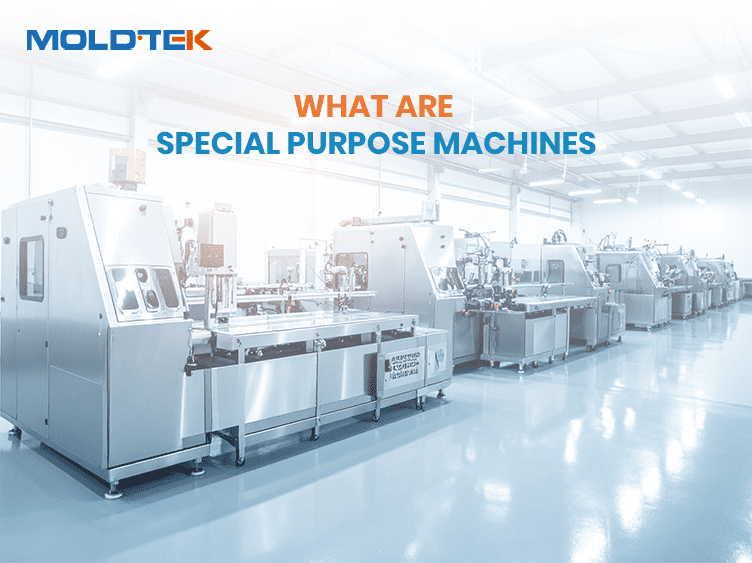
Special Purpose Machines (SPMs), also known as Specific Purpose Machines, are custom-designed systems built to execute a particular task with high precision, speed, and efficiency. Unlike general-purpose equipment, SPMs are engineered to fulfill unique requirements within a production process, making them invaluable for industries that demand automation, reliability, and accuracy.
At Moldtek Engineering, we bring decades of experience in structural steel, PEB, precast, mechanical, and telecom design to help manufacturers and infrastructure developers unlock the full potential of SPMs. From precision metalworking in Texas to PEB optimization in Hyderabad, our integrated engineering services deliver speed, savings, and superior results.
Key Characteristics of Special Purpose Machines
Custom-Built:
Every SPM is designed and manufactured based on specific operational requirements rather than mass production standards.
Highly Specialized Function:
These machines are crafted to carry out a single task or a narrow range of tasks with exceptional efficiency.
High Precision and Accuracy:
Especially in industries like aerospace or electronics, SPMs maintain tight tolerances and consistent output quality.
Automation-Driven:
SPMs automate repetitive and critical processes, reducing manual intervention and human error.
Long-Term Cost Savings:
While initial investment might be higher, their tailored design boosts productivity, cuts labor costs, and minimizes material waste.
Where Are SPMs Used?
Industries that rely heavily on SPMs include:
Automotive:
For welding stations, robotic assembly lines, and engine testing units.
Aerospace:
To manufacture precision components like turbine blades and engine parts.
Electronics:
For PCB assembly, microchip soldering, and circuit integration.
Packaging:
Automated machines for filling, labeling, and sealing.
Textile & Woodworking:
Custom machinery for weaving, dyeing, cutting, and shaping.
Metalworking:
For bending, forming, and machining of specialized metal components.
Why Specific Purpose Machines Matter for Today’s Infrastructure and Manufacturing Leaders
In an era where customization, automation, and speed-to-market are competitive differentiators, Specific Purpose Machines (SPMs) are no longer optional they are mission-critical. Defined as engineered equipment tailored for one primary operation, SPMs help industries automate complex tasks with minimal human intervention.
Whether supporting a telecom tower rollout in South India or accelerating precast production in Pune, specialized machinery is reshaping how operations leaders think about efficiency.
At Moldtek Engineering, we combine over 20 years of global design experience with deep domain expertise in BIM-based fabrication workflows, Tekla-based detailing, and mechanical CAD automation to support end-to-end SPM implementation.
What Makes a Machine “Specific Purpose”?
Unlike general-purpose machines, Specific Purpose Machines (SPMs) are:
- Custom-built to meet unique operational goals
- Designed for singular, repetitive, or high-precision tasks
- Engineered for seamless integration into production lines
- Optimized for speed, reliability, and long-term ROI
These machines are frequently deployed in:
| Industry | Common SPM Applications |
| Automotive | Robotic welding systems, engine testing rigs |
| Aerospace | Turbine blade assembly jigs, precision drilling stations |
| Precast & PEB | Automated bending machines, steel cutting frames |
| Telecom | CNC-based antenna bracket fabrication, tower part cutting |
| Manufacturing | Injection molding machines, material handling systems |
Why Specific Purpose Machines Are Game-Changers in AEC and Manufacturing
1. Precision Engineering That Minimizes Waste
SPMs ensure near-zero deviation in high-tolerance tasks. For example, in structural steel detailing, even a 1mm misalignment can translate to costly rework. Systems built with AutoCAD, Tekla, or SolidWorks templates streamline this precision.
2. Faster Production with Less Human Intervention
Integrated into BIM-coordinated workflows, SPMs can auto-execute production logic, reducing typical cycle times by 30–50%.
3. Customization Meets Scalable Repetition
SPMs are both fit-to-function and scale-replicable. In PEB structures across Hyderabad, Pune, and Dubai, repetitive portal frame connections benefit from specialized welding or jig-based automation systems, all coordinated via Moldtek’s standard connection libraries.
How Moldtek Engineering Powers SPM-Ready Design
Moldtek offers a converged engineering skillset, integrating:
- Steel Detailing with Tekla, SDS/2, AutoCAD
- Mechanical CAD Automation with SolidWorks & Creo
- Precast and PEB Modeling using Revit and BIM360
- Telecom Structure Design (5G, rooftop towers, monopoles)
- SPM Engineering for manufacturing plants
Typical SPM-Enabled Project Workflow at Moldtek
| Stage | Description |
| Requirement Gathering | Understand client application, material flow, production goals, and constraints |
| Conceptual Design | Develop 3D simulations, CAD layouts, and preliminary functional schematics |
| Modeling & Detailing | Create detailed fabrication drawings using SolidWorks, Revit, or Tekla |
| Prototyping | Coordinate with vendors to develop physical prototypes for review |
| Validation & Simulation | Conduct load, vibration, and stress testing using FEA/CFD tools |
| Final Commissioning | Integrate the machine into the client’s workflow with operator training and documentation |
Talk to Our Engineering Team Now
Looking to integrate precision automation or expand infrastructure faster? Let our experts help you customize a Specific Purpose Machine design that aligns with your long-term goals.
Contact Us for an Engineering Evaluation Now
What Tools Power Our SPM-Compatible Designs?
| Tool | Usage |
| Tekla Structures | Fabrication-ready steel detailing |
| Revit + BIM 360 | Precast modeling and BIM coordination |
| AutoCAD / SolidWorks | 2D and 3D mechanical modeling for SPM components |
| Navisworks | Clash detection and multi-discipline coordination |
| SDS/2 | Advanced steel connection design and fabrication support |
Future of SPMs: AI, IoT, and BIM Integration
Moldtek is actively exploring AI + IoT convergence to:
- Predict maintenance for welding jigs
- Integrate digital twins into SPM-ready production lines
- Use BIM intelligence for just-in-time machine feed designs
Explore Our Global Engineering Solutions
From custom automation in manufacturing plants to end-to-end telecom tower modeling, Moldtek Engineering empowers businesses to build smarter, scale faster, and reduce rework.
Special Purpose Machines (SPMs), also known as Specific Purpose Machines, are custom-designed systems built to execute a particular task with high precision, speed, and efficiency. Unlike general-purpose equipment, SPMs are engineered to fulfill unique requirements within a production process, making them invaluable for industries that demand automation, reliability, and accuracy.

About the Author
By Vamsi Posemsetty
EVP – Global Strategy & Operations, Moldtek Technologies
Founder & CEO, Zenitude Technologies
Vamsi Posemsetty brings 20+ years of global experience in manufacturing, engineering services, and enterprise technology transformation. At Moldtek, he leads strategy and delivery across structural steel detailing, BIM modeling, and industrial projects.
He has held leadership roles at Microsoft, Tata Motors, Mahindra & Mahindra, and GE across the US, Europe, and Asia. Now at Zenitude Technologies, he focuses on AI-powered platforms for industrial upskilling.
A thought leader in real-world AI adoption in engineering, Vamsi was part of ISB Hyderabad’s founding cohort (Business Analytics, 2013) and is the upcoming author of “AIM: Unlocking the AI Mindset.”