
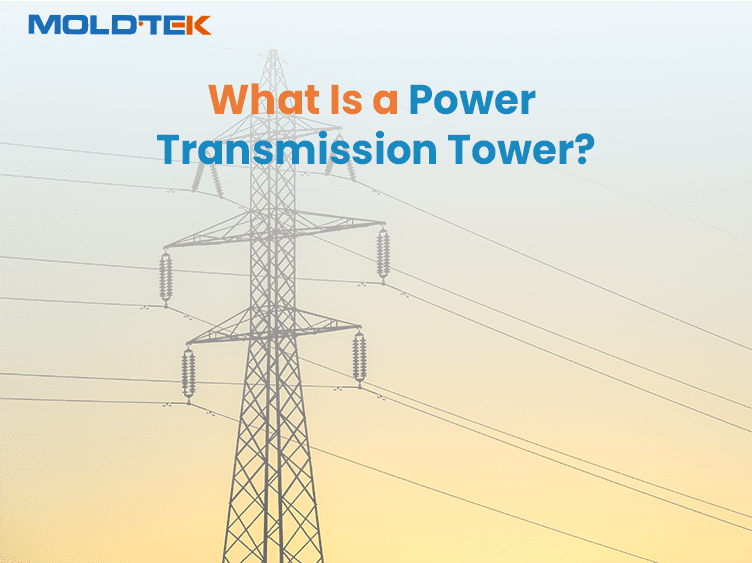
A power transmission tower is a tall structural system designed to support overhead electrical conductors that carry electricity at high voltage across long distances. These towers are a fundamental component of power transmission networks, enabling electricity generated at power plants to be delivered to substations and regional distribution systems in a controlled and safe manner.
By elevating energized conductors above ground level, power transmission towers maintain required electrical clearances from people, buildings, vegetation, and other infrastructure. Their height and structural configuration allow transmission lines to span long distances while ensuring operational safety, system reliability, and uninterrupted power flow.
Role of Power Transmission Towers in the Electrical Grid
Power transmission towers form the physical backbone of the electrical grid. Electricity is often generated far from consumption centers, making long-distance transmission essential. Towers support overhead transmission lines that transport bulk electrical energy between power plants, substations, and interconnection points across regions.
These structures also enable grid interconnectivity, allowing electricity to be rerouted when demand fluctuates or when certain transmission paths are unavailable. As a result, transmission towers play a key role in grid stability, redundancy, and regional power balancing.
Key Functions of Power Transmission Towers
Supporting High-Voltage Conductors
Transmission towers carry conductors, insulators, and fittings that transport electricity at high voltage. The structural system is designed to safely support conductor weight, tension forces, and environmental loads without excessive deformation.
Maintaining Safety Clearances
One of the primary functions of a power transmission tower is to ensure safe separation between energized conductors and the surrounding environment. Adequate ground and phase-to-phase clearances reduce the risk of electrical hazards, flashovers, and interference with nearby infrastructure.
Enabling Long-Distance Power Transfer
Overhead transmission supported by towers allows electricity to be transported efficiently over long distances with relatively low energy loss compared to underground systems. This makes transmission towers essential for large-scale power networks.
Materials Used in Power Transmission Towers
Most power transmission towers are constructed using lattice steel, chosen for its strength-to-weight ratio, durability, and resistance to environmental conditions such as wind and corrosion. The open lattice configuration also minimizes wind loading while maintaining structural stability.
Depending on project requirements, other materials may be used:
- Tubular steel for space-constrained or urban locations
- Reinforced concrete where durability and low maintenance are priorities
- Wooden structures are typically limited to lower-voltage or short-span applications
Material selection is influenced by voltage level, span length, terrain, environmental exposure, and applicable standards.
Height and Structural Characteristics
The height of a power transmission tower varies based on terrain, span length, and clearance requirements. In general:
- Typical tower heights range from 15 to 55 meters
- Towers used for river crossings, valleys, or wide corridors may be significantly taller
Tower geometry is designed to account for conductor sag, wind pressure, temperature variation, and mechanical loading. Structural members are proportioned to ensure long-term stability under both normal and extreme operating conditions.
Types of Power Transmission Towers
Suspension Towers
Suspension towers are installed along straight sections of transmission lines. They primarily carry vertical conductor loads and allow limited horizontal movement. These towers are placed at regular intervals and form the majority of the towers along a transmission route.
Tension (Dead-End) Towers
Tension towers are used where transmission lines change direction, terminate, or cross long spans. They are designed to resist higher mechanical forces resulting from conductor tension and directional loads.
Special Application Towers
Custom-designed towers are used in locations with specific constraints, such as:
- River and water crossings
- Mountainous or uneven terrain
- Dense urban corridors
These designs address increased span lengths, height requirements, or restricted right-of-way conditions.
Engineering Design Considerations for Transmission Towers
The design of power transmission towers involves evaluating multiple load cases, including wind forces, conductor tension, temperature effects, and in some regions, seismic loading. Foundations are designed based on soil conditions, tower loads, and environmental factors to ensure long-term stability.
Accurate tower geometry and alignment are critical to maintaining conductor clearance, minimizing energy loss, and ensuring compatibility with transmission line hardware and foundations.
Power Transmission Tower Design Support Perspective
From an engineering services standpoint, power transmission tower design focuses on structural accuracy, load analysis, and coordination with transmission line requirements. Engineering support typically involves developing detailed tower layouts, analyzing load combinations, and preparing design documentation suitable for regulatory review and construction coordination.
At Moldtek Engineering, engineering involvement in power transmission tower design is aligned with utilities and infrastructure projects where precise structural modeling, compliance with standards, and constructability considerations are essential. This support ensures that tower designs integrate effectively with transmission lines, foundations, and right-of-way constraints without addressing execution or installation activities.
Additional Uses of Power Transmission Towers
In some cases, transmission towers may accommodate secondary systems such as telecommunication or broadcasting equipment. Towers may also be equipped with monitoring devices or meteorological instruments to collect data related to wind, temperature, or environmental conditions that influence transmission performance.
Such integrations are evaluated carefully to ensure they do not compromise structural integrity or electrical safety.
Conclusion
A power transmission tower is a critical structural element that supports overhead high-voltage conductors and enables long-distance electricity transfer. Through appropriate material selection, structural design, and placement, transmission towers ensure safety, reliability, and efficiency within electrical grids. Understanding their function, types, and design considerations is essential for engineers involved in power, utility, and infrastructure projects.
This article explains what a power transmission tower is and its role in electrical transmission systems. It covers the key functions, common types of transmission towers, materials used, structural characteristics, and engineering design considerations for supporting overhead power lines.

About the Author
By Abhishek Suresh
Deputy Manager – Marketing at Moldtek Technologies
A distinction holder in MSc International Management from Trinity College Dublin and a semi-qualified Chartered Accountant (CA – IPCC from India) with an undergraduate degree in the field of accountancy and finance. I am currently working at Moldtek Technologies Ltd as a Deputy Manager, Marketing, taking care of the entire marketing activities of the business.